Local Plan Review 2026-2043 Issues and Options Consultation
Regional Planning Context
- Until 2010 strategic planning was undertaken through the production of Regional Spatial Strategies, but these were then replaced with a duty-to-cooperate. This meant that Councils in the Housing Market Area[8] (HMA) would work together so that individual local plans would address the area’s needs, including the scale and distribution of growth.
- The Government is working towards reintroducing formal strategic planning across wider areas than individual local plans and it is expected that, at least in part, this will be achieved through the production of a Spatial Development Strategy (SDS) for the West Midlands. The West Midlands Combined Authority (WMCA) will be responsible for producing this plan.
- As the WMCA describes:
A SDS is a long-term plan that set outs where new homes, jobs, transport and green spaces should go across the whole region. Instead of each council planning in isolation, it joins things up, so growth is balanced and makes sense across towns and cities.
It helps protect important natural habitats and green spaces while guiding investment into highly sustainable locations.
- In July 2025 the WMCA Board approved the initiation of the project which includes establishing governance and working arrangements, a public and stakeholder engagement plan and the adoption of eight guiding principles to inform the development of the SDS at each stage. The intended timescale for the SDS is as follows:
- Summer 2025 – Spring 2026 – SDS initiation and scoping including: commissioning evidence base, establishing working groups and wider governance, and initial public & stakeholder engagement.
- Spring – autumn 2026 – Issues and Options Consultation (following publication of regulations and guidelines).
- Winter 2026 – Spring 2027 – Publication of draft SDS and public consultation.
- Spring 2027 – Winter 2027 – Public examination.
- Spring 2028 onwards – Adoption, monitoring and review.
- The eight principles to guide the development of the SDS are as follows:
- Co-development and Equality of participation - All LAs participate as equal partners with respect for different priorities and relationships.
- Timing and momentum - To set firm timelines against each milestone in line with the Regulations, whilst allowing sufficient space and time for internal discussions on all aspects of the SDS.
- Infrastructure First – growth must be supported by the guarantee of provision of transport, energy, green and blue infrastructure and social infrastructure. The SDS can make this explicit in terms of timing and costs associated with different growth options.
- Brownfield First – the SDS must maximise the use of previously developed land consistent with national and local priorities. However, alternative sources of land supply will be required to be identified given anticipated levels of need and finite availability of sites within the existing urban area. There will need to be a consistent approach to any greenfield or Green Belt release activity, and an opportunity to give priority to suitable sites in highly sustainable locations.
- Enhancing the functions of green spaces - the SDS must recognise the strategic importance of green open spaces in the West Midlands and establish a consistent and positive approach to Green Belt land beyond the principal planning purposes of preventing urban sprawl and the merging of towns. The SDS should seek to enhance the wider functions of green open spaces ,including giving priority to i) protecting and enhancing natural habitats and promoting biodiversity, ii) enabling access to recreational land, iii) protecting and establishing carbon-sequestering land uses, and iv) recognising that successful growth and the promotion of the region requires these spaces.
- Additionality to local plans – the SDS must provide additionality to and not replicate the content of Local Plans produced by the local authorities. The SDS must also be sufficiently detailed to enable Local Plans to understand the implications of the SDS policies and proposals for application at the local level, for example in relation to the identification of growth areas and infrastructure.
- Evidence-led – the SDS must be based on a comprehensive and robust evidence base, with all policies and proposals fully justified and capable of withstanding challenge at examination.
- Integration – the SDS must be fully integrated with and support the delivery of key national, regional and local priorities and programmes, most significantly in relation to the Local Transport Plan, Regional Energy Strategy, Local Nature Recovery Strategy and the Local Growth Plan (regional industrial strategy).
- Co-development and Equality of participation - All LAs participate as equal partners with respect for different priorities and relationships.
- Local plans within the area covered by the SDS will be expected to be in general conformity with it. This means that the scale of growth to be included in local plans will be largely determined by the SDS.
- It is anticipated that an SDS would be adopted by a simple majority vote of the constituent authorities with the West Midlands Mayor having a casting vote in the event of a tie.
Duty to Cooperate (DtC)
DtC and Local Plans
- Plans prepared under the current plan-making arrangements are required to fulfil both a legal and policy test in order to demonstrate that the Council has fulfilled its duty to cooperate obligations. Important updates with regard to the DtC have been given by way of letters from the Minister of State for Housing and Planning to the Planning Inspectorate dated 9th October 2025 and 27th November 2025.
- This includes the following from the October letter:
“We have also been clear about the importance of effective strategic planning across local planning authority boundaries, both to support the effective distribution of housing across appropriate geographies and also provide high-level frameworks for infrastructure investment. I look forward to welcoming the development of Spatial Development Strategies across England following the passage of the Planning and Infrastructure Bill.
In advance of the new plan-making system and mechanisms for cross-boundary cooperation coming into force, the final set of local plans being delivered within the current system remain essential to facilitating the effective delivery of housing, jobs and infrastructure. It is therefore critical that Inspectors approach examinations of current system plans with the appropriate degree of flexibility. The evidencing of expectations to establish whether the legal and soundness tests have been met – including with respect to the Duty to Cooperate – should be proportionate to the context in which plans in the existing system are being prepared.”
- This includes the following from the November letter:
“The new plan-making system provided by the Levelling Up and Regeneration Act 2023 does not include the Duty. Instead, the new system will rely on revised national policy and the new tier of strategic planning to ensure effective co-operation between plan-making authorities. The Regulations for the new system will also ‘save’ the current plan-making system for a period to allow emerging plans to progress to examination by 31 December 2026. Given the above, and to help drive local plans to adoption as quickly as possible and progress towards our objective of universal local plan coverage, we have decided not to ‘save’ the Duty, thereby removing this requirement for plans in the current system.
The Duty will therefore cease to apply when the Regulations come into force early next year, including for plans at examination at that point. On the basis of the government’s firm intention to abolish the Duty for the current system, examining Inspectors may wish to begin any necessary dialogue with LPAs in advance of the Regulations coming into effect, with reference to this letter. Of course, LPAs should continue to collaborate across their boundaries, including on unmet development needs from neighbouring areas and Inspectors should continue to examine plans in line with the policies in the NPPF on ‘maintaining effective co-operation’”.
- This approach is particularly noteworthy for plans being bought forward under the legacy system as it signals a degree of pragmatism around the DtC and that, depending on circumstances, the role SDS’s will have with regard to ensuring cross boundary collaboration takes place.
DtC and Strategic Plans
- An important part of the new plan-making arrangements will be how the DtC will work between SDS areas. This is particularly important in the West Midlands as the area to be covered by the SDS is only part of the functional Housing Market Area.
- Appendix C to this document sets out the current position other Councils are at with their plan-making.
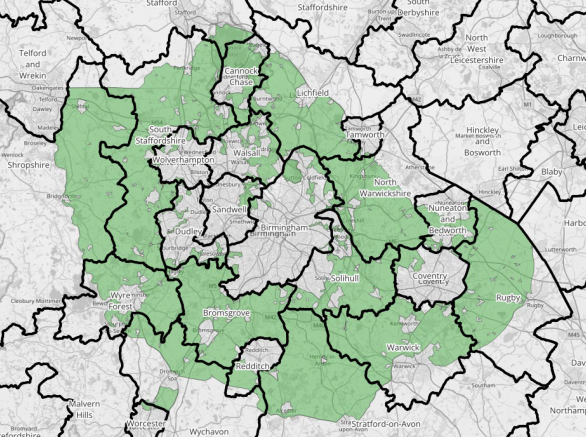
[8] Birmingham, Bromsgrove, Cannock Chase, Dudley, Lichfield, North Warwickshire (also in Coventry & Warwickshire HMA), Redditch, Sandwell, Solihull, South Staffordshire, Stratford-on-Avon (also in Coventry & Warwickshire HMA), Tamworth, Walsall and Wolverhampton.
