Local Plan Review 2026-2043 Issues and Options Consultation
What Will Happen Whilst a New Plan is Being Prepared?
- Whilst the plan remains under preparation the Council has received, and expects to continue receiving, planning applications for new development within the Borough. Since the publication of the NPPF and NPPG in 2024/2025 there has been an upturn in major applications for development within the Green Belt, often claiming to be ‘Grey Belt’ land and aiming to satisfy the ‘Golden Rules’. A number of these applications have been determined, with the majority thus far relating to sites previously proposed for allocation in the now withdrawn Local Plan Review.
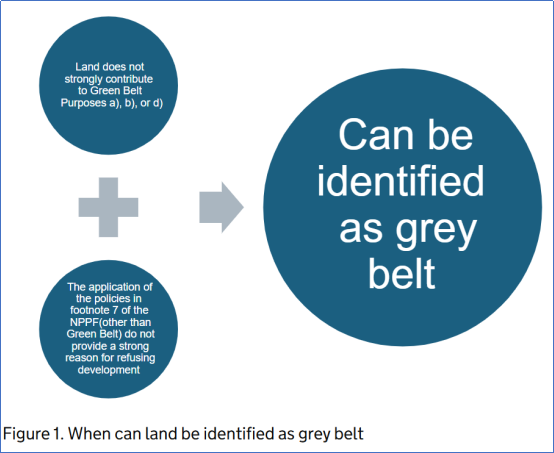
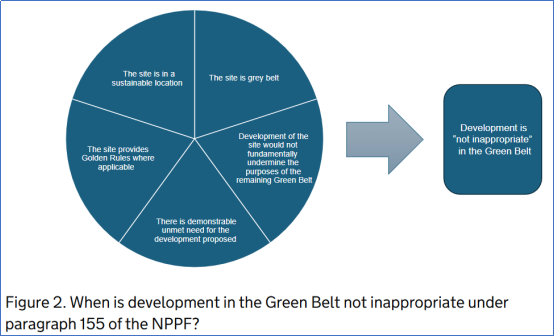
- However, just because land may be identified as Grey Belt, it does not follow that it should be developed. Effectively, there is a two-stage process, as illustrated in the NPPG[71]:
- As a Local Planning Authority (LPA), the Council has a legal duty to determine any planning application that is submitted to it. National guidance recommends that such decisions should be made within prescribed timescales, however there is scope to agree extended time periods with an applicant, and this is common, especially when considering the complex and sensitive nature of larger applications within the Green Belt. Nevertheless, failure to determine an application can lead to an applicant appealing against non-determination meaning the Council loses the right to decide the application locally and it is instead determined through the Planning Inspectorate. National Performance markers mean that if this happens too often or the Council experiences a high proportion of decisions allowed on appeal, then applicants can apply directly to the Planning Inspectorate and the council lose the right to make its own decisions.
- In this context, the LPA will continue to assess and determine planning applications as appropriate. Such decisions will have regard to the adopted development plan (including the 2013 Local Plan and Neighbourhood Plans) as well as the NPPF and NPPG (as required by planning law). The new Plan will not apply to planning applications until it becomes more advanced. Where an application meets specific requirements, it will be presented to the Councils Planning Committee to determine. This is common with larger development sites within the Green Belt.
- Further to the above, should the Council refuse an application, then it is important to note that the applicant has the right to appeal that decision to the Planning Inspectorate. This could lead to the Council’s decision being upheld or overturned.
- Whilst the Council will continue to encourage applicants to first promote speculative development options through the Local Plan process, as referenced above this is not something the Council can enforce, and any application that’s submitted must be considered on its own merits and determined accordingly. In some cases, an argument may be made that an application is premature. This concept is referenced within Para 50 and 51 of the NPPF. This states:
“….in the context of the Framework – and in particular the presumption in favour of sustainable development – arguments that an application is premature are unlikely to justify a refusal of planning permission other than in the limited circumstances where both:
a) the development proposed is so substantial, or its cumulative effect would be so significant, that to grant permission would undermine the plan-making process by predetermining decisions about the scale, location or phasing of new development that are central to an emerging plan; and
b) the emerging plan is at an advanced stage but is not yet formally part of the development plan for the area.”
- The reference to “advanced stage” in the NPPF, normally means the Plan has been submitted for examination. As a result, prematurity is unlikely to be a reason for refusal within the Borough unless the impacts of the proposed development are so substantial that it would prejudice the outcome of the plan making process.
- The Council is aware of concerns raised within local communities regarding piecemeal development and the potential impacts on local infrastructure. Although this could give the appearance of development being uncoordinated, the Council will always use all opportunities within the NPPF and NPPG to secure:
- Comprehensive and aligned developments; and
- Coordinated contributions towards necessary infrastructure provision.
- In this respect, and when considering multiple applications within a specific area the Council will always seek to have regard to cumulative impacts of developments, in accordance with national policy and guidance. In order to allow for cumulative considerations to be taken into account though, the sites in question must have a degree of certainty that they will be delivered. This will include any sites already under construction or granted planning permission or normally those which are under assessment as part of a live application. It can also include any sites that are allocated within an adopted or advanced[72] plan in a neighbouring area.
- In all cases where a planning application for new homes is granted permission (either by the Council or on appeal), this will count towards the Council’s housing land supply during the Plan Period referenced within this paper.
[71] The reference to compliance with the Golden Rules ‘where applicable’ in figure 2 is due to the fact that the rules only apply to major housing development, and therefore it excludes other forms of development.
[72] By “advanced” this would normally mean proposed for allocation as part of a plan submitted for examination.
