Local Plan Review 2026-2043 Issues and Options Consultation
Calculating Local Housing Need
- An updated standard method[14] (SM) for calculating Local Housing Need (LHN) was included in the December 2024 NPPF. In making the changes the Government stated:
“We are therefore restoring mandatory housing targets. This means that local authorities must use the standard method as the basis for determining housing requirements in their local plans.”[15]
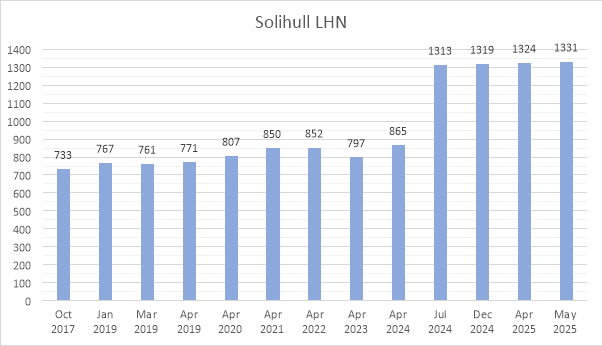
- In the 2020 plan the local housing requirement was established at 816 dwellings per annum (dpa). Under the new SM the LHN for the Borough would increase to 1,331[16] dpa. This represents an increase of 515 dpa (63%). Over the course of a typical plan period (18 years) this would increase the number of dwellings to be accommodated by around 9,270 dwellings. The graph below illustrates the changes to LHN over time[17]:
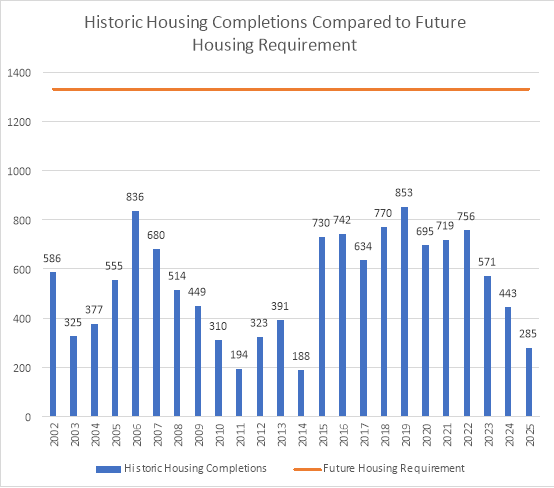
- The following graph helps illustrate a comparison between the LHN figure now expected to be delivered, and past housing completions[18].
Housing Requirement in the Solihull Local Plan 2020
- The now withdrawn plan was based on a Local Housing Number (LHN) of 816[19] dpa. It also included a c2,000 contribution towards meeting unmet needs of Birmingham.
- The plan period was to be 2020-36 (i.e. 16 years) and would have provided for 15,017 dwellings.
- During the examination, the Council was requested to extend the plan period to 2037 (making the plan period 17 years) and this made provision for a revised housing requirement of 15,873 (i.e. average of 934 dpa), which was accepted by the Inspectors.
Housing Requirement in the Emerging Local Plan
- It is anticipated that the plan period for the new plan will run from 2025 to 2043 (i.e. a period of 18 years). This is on the basis that evidence being used/prepared for the new plan will have a base date of April 2025; and if the plan is to be adopted in 2028 then it should have a 15-year time span post adoption, thus running up to 2043. Based on a plan period of 18 years, the housing requirement would be 23,958 dwellings[20].
- Whilst there is certainty about what the LHN figure produces, there is current uncertainty about how this figure will be influenced by the West Midlands Spatial Development Strategy (SDS). In this respect the SDS may result in a lower figure for Solihull; or it may conclude that it is appropriate for Solihull to accommodate just its own needs; or it may seek that Solihull provides for more than its own needs.
- Furthermore, plan preparation by other Council’s, both in the CA area and wider Housing Market Area may have implications in this respect. For instance, some of the Black Country authorities have indicated that they will be unable to accommodate all of their own growth, whereas Birmingham City Council’s latest plan appears to indicate a surplus[21].
- As noted in an earlier chapter, the approach to the duty-to-cooperate is likely to change for plans being bought forward under the legacy system with the legal test falling away; and the greater flexibility Inspectors are encouraged to take. This in the context that the new plan-making system will rely on the new tier of strategic planning to ensure effective co-operation between plan-making authorities.
- It is in this context that the Council’s preferred approach is that the plan to be brought forward under the legacy plan-making system will be one that accommodates its own needs only. The Council will continue to positively engage with other authorities, both within the WMCA area and wider Housing Market Area, to bring forward the first SDS for the West Midlands. It is believed that this would be the most appropriate mechanism for addressing any unmet needs that can’t be met in situ in other areas, in a consistent, comprehensive and more robust manner.
- Whilst at this stage the Council cannot be more certain about the level of growth that will need to be included in the emerging plan, it is keen to get stakeholders views on this issue.
7. Do you believe it is appropriate for the Council, through this plan-making process, to just seek to accommodate its own needs with any necessary redistribution of housing needs to be addressed through the emerging West Midlands Spatial Development Strategy, if not why?
[14] The SM now uses a 0.8% increase in housing stock (per annum) as the starting point for calculating LHN. This replaces the household projections as the starting point under the old method. An affordability uplift (based on a comparison between median house prices and median workplace-based earnings) remains a part of the method, but with an increased uplift. Over the period 2017 to 2014 the uplift varied between 22% and 34%. It is now 73%.
[15] “Building the homes we need” - Statement made by Matthew Penncook (Minister of State for Housing and Planning) on 12 December 2024
[16] This uses affordability data as of April 2025 and housing stock figures as of May 2025.
[17] The timescales used are a combination of dates that represent both changes to the standard methodology and changes to the data inputs, hence it’s not a uniform linear scale.
[18] Year ending 31st March.
[19] 807 dpa as a result of the standard method with a modest increase to reflect growth aspirations at UK Central Hub.
[20] LHN of 1,331 dpa x 18 years.
[21] Currently it’s not yet clear whether this is a surplus that could offset unmet need arising elsewhere, or whether the Council will incorporate it as a buffer to their supply.
Document control: v2 4th February 2026: Typo in footnote 21 corrected.
