Draft Submission Plan (Regulation 19)
Promoting Sustainable Travel Comment
Vision Led Approach
329.The National Planning Policy Framework promotes a vision-led approach to transport planning. This will help to ensure that transport and land use planning issues are integrated from the earliest stages of development. The previous transport approach was to ‘predict and provide’, where likely traffic impacts were predicted or modelled and then infrastructure was provided to mitigate those impacts. The vision-led approach seeks to shape patterns of growth and movement that support sustainable and well-connected places. The Council will work with transport authorities, infrastructure providers and developers to ensure that development contributes to achieve this approach which will support the delivery of the spatial strategy and wider Local Plan objectives. Comment
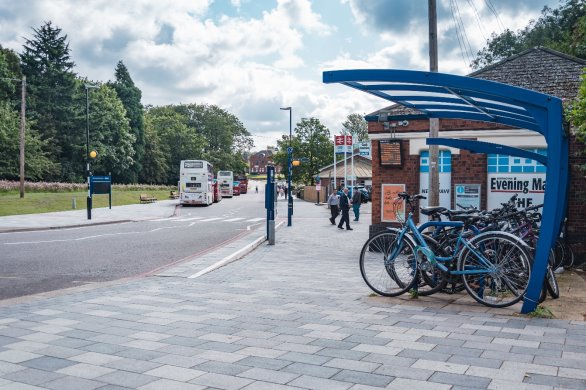
The Council’s Vision Led Approach
330.A simple vision of places where people will be able to live without depending on their cars. To achieve this, we will support the development of business and housing proposals that: Comment
- Are tied into the existing travel networks so people have a choice when it comes to deciding how to travel.
- Consider connections between more than one development site to allow for through trips on foot, on bike or by bus.
- Create places where people with reduced mobility or who are elderly or infirm can live and travel independently.
- Provide access to bus and rail networks through connections to existing infrastructure or offering new infrastructure. This may be as simple as providing additional seating. Our population is forecast to grow in age.
- Provide safe routes for active travel and connect to existing networks.
- Reduce the need for travel and the distances that people travel.
331.Proposals that are forecast to generate a significant rise in trips should provide a transport assessment or transport statement that shows how the new proposal will impact cycling, roads and junctions, public transport and walking along with any other transport impacts. This will enable us to decide if the impacts of the new proposal are manageable within the existing network and enable us to draw up a mitigation plan to implement alongside the new proposal. Comment
332.Those new proposals that do generate a significant rise in trips should be located in a sustainable location, close to existing services and facilities that will reduce the reliance on the private car. These will normally (but not exclusively) be situated near existing local centres, district centre or the three larger centres in the Borough (Chelmsley Wood, Shirley and Solihull). The new proposals should be adjacent to and connected to the bus, cycle, rail, and walking networks either through use of the existing network or adding to the existing network, for example through extensions to existing bus links or providing new cycle parking opportunities. Where shortfalls in service provision are identified contributions may be deemed appropriate through Section 106 agreements to support enhancement to services. Comment
333.New proposals will also need to consider highway access, impacts on public rights of way, onsite parking and where relevant existing highway safety concerns. Comment
334.Successful delivery of our Vision led Transport Approach will: Comment
- Address the objectives in the Local Plan and Solihull Connected.
- Extend the coverage of the transport network across our Borough.
- Improve safety on our transport network.
- Improve the quality of life in the Borough.
- See that all the Borough can access health, employment, leisure, education and retail opportunities.
- Support steps to encourage economic growth and productivity.
Transport Strategy
335.The West Midlands Combined Authority, has through its ‘Movement for Growth’ strategy set out the strategic direction for the region, while the Council’s transport strategy ‘Solihull Connected’ (adopted 2023) sets out the strategic vision for managing the quality and performance of the transport system within Solihull and connections with the rest of the region and the UK. The Combined Authority is in the process of preparing a new Local Transport Plan for the West Midlands. Comment
336.Solihull Connected has four primary objectives: Comment
- Objective 1: To make the transport network accessible to all people
- Objective 2: To help the economy grow in a way that is equal and fair for everyone
- Objective 3: To be safe and secure for all users
- Objective 4: Transport will contribute to improving the quality of life in our Borough
337.Both ‘Movement for Growth’ and Solihull Connected support an approach of expanding the public transport network in the Borough, developing bus, bus rapid transit, rail and ultimately Metro. Comment
338.Planning applications that include upgrades to the following to support the transport policies in the West Midlands Local Transport Plan and Solihull Connected transport strategy will be welcomed: Comment
- Accessibility and the spread of step-free routes.
- Bus routes and bus waiting facilities. This may include on site roads that connect developments, bus priorities, turning circles and/or the vehicles themselves.
- Cycle routes and cycle parking.
- Measures to improve air quality and reduce carbon emissions from transport.
- Measures to improve the resilience of the transport network during periods of extreme weather conditions.
- Mobility hubs particularly at local centres or the district centres.
- Railway stations.
- Road safety.
- Walking routes including public rights of way and/or canal towpaths.
339.The UKC Hub will be one of the country’s most strategically important development sites and one of the region’s major drivers of economic growth. The ambition is to create a globally renowned and internationally connected destination for business, leisure and living, facilitated by the Council with wider support from local, regional, and central Government. Developments that form part of the UKC Hub, will be expected to contribute to the transport strategy for the area. Comment
340.To inform transport policy, the following documents have been adopted by the Council: Comment
- Cycle & Walking Strategy (2021)
- Local Cycle Walking Investment Plan (2021)
- Solihull Connected (2023)
- Air Quality Strategy (2024)
- Electric Vehicle Strategy (2025)
- Climate Change Action Plan (2026)
- Highway Network Management Plan (2026)
341.In addition, several partners produce documents that have an important influence on how travel and transport will evolve in the Borough. Some of these are listed below: Comment
- Birmingham Airport: Surface Access Strategy
- National Exhibition Centre: NEC Masterplan
- National Highways: Road Investment Strategy Delivery Plan
- Network Rail: Long Term Planning Process
- Transport for West Midlands: Local Transport Plan (Movement for Growth) and West Midlands Freight Strategy
- West Midlands Rail Executive: West Midlands Rail Investment Strategy
342.The development of policies in this section of the draft local plan have had regard to Solihull’s role in the wider area recognising that both national road and rail networks cross through the Borough. Comment
343.The Borough Portrait and Challenges identify the local transport issues in the Borough. This includes the difficulty in delivering sustainable modes of transport in the rural parts of the Borough, due to the number of small settlements and dispersed population, whilst many of the Borough’s roads suffer from congestion during peak hours. As well as creating social exclusions these issues can in turn detract from Solihull’s attractiveness as a place to live, work and learn whilst also supressing its economic potential. Effective land use planning can, however, make a positive contribution towards rebalancing the transport system by influencing the location of development; supporting rural transport and encouraging take up of sustainable modes of transport. Comment
Cycling and Walking Strategy
344.To support Solihull’s Transport Strategy ‘Solihull Connected’ the Council has adopted a Cycling and Walking Strategy for the Borough. Comment
345.Cycling and walking are recognised as important components to reduce congestion, improve air quality and support better physical and mental health. Cycling and walking have the real potential to enhance the vibrancy and special character of our Borough whilst providing opportunities to enhance connectivity and accessibility. Comment
346.The Cycling and Walking Strategy presents the Council’s overall approach to active travel in the Borough. The strategy sets out our vision for how we will deliver cycling and walking infrastructure, how we will improve the capability and confidence of our residents to cycle and walk more often and how we will ensure new developments cater for cycling and walking. Comment
347.The Cycling and Walking Strategy is a key step in our approach to accommodate growth in travel demand on our network while maintaining Solihull’s special character. Comment
348.Purpose of the Cycling and Walking Strategy: Comment
- set the overall vision for cycling and walking in Solihull
- set a clear standard for cycling and walking infrastructure
- ensure major developments consider active travel - more sustainable approach to transport
- embed cycling and walking initiatives into local policy
349.As part of the strategy, we have produced a Local Cycling and Walking Infrastructure Plan (LCWIP). LCWIPs identify cycling and walking improvements required at a local level. The Solihull LCWIP enables a long-term approach to developing a local cycling and walking network within the Borough. The aim of the Solihull LCWIP is to improve cycling and walking infrastructure across the Borough over the next ten-year period. Consideration may also be given to, where appropriate, enhancing PROWs to be bridleways not just footpaths. Comment
350.The Council notes that NDMP TR3 relates to locating development in sustainable locations and a further local plan policy is not considered to be required. Comment
Policy SMBC/TM1: Rapid Transit Comment
- The Council will support the principle of proposals for the delivery of Metro and Sprint as part of a network of rapid-transit lines across the West Midlands, particularly along the following corridors in the Borough that provide access to UK Central Hub:
- From Digbeth and the east of Birmingham to UK Central Hub.
- From Blythe Valley to central Solihull, UK Central Hub and Chelmsley Wood.
- From Hall Green to central Solihull and UK Central Hub.
- Where development proposals sit either within or adjacent to these corridors, they will be requested to contribute towards the delivery of Metro or Sprint (as appropriate). In addition, developments will be expected to design in access opportunities to ensure connectivity to rapid transit infrastructure is maximised from the outset.
Rapid Transit
351.An efficient and accessible inter-connected rapid-transit network can play a vital role in improving the current transport system both locally and regionally whilst accommodating forecast increases in travel demand. The network can also help support wider urban regeneration and, in a more local context, go some way to reducing the transport severance between North and South Solihull. Comment
High Speed 2 Rail
352.The HS2 Act received Royal Assent in February 2017, with the Notice to Proceed issued in April 2020 and construction works are now underway; with the line expected to be open between 2036-39. Comment
353.The Act provides the powers and land necessary to construct and operate High Speed 2. Detailed matters relating to design and construction arrangements will be submitted to, and considered by, the Council as the approval body (termed ‘Qualifying Authority’) under the HS2 Planning Regime. Comment
354.However, the Act also ‘disapplies’ many aspects of national, regional and local legislation and policy, replacing it with that which is more directly relevant to the design and delivery of the railway. Specific grounds are set out upon which HS2 related applications can be considered, conditioned or refused; meaning that the policies set out in this Plan cannot be applied by the Council in the usual manner when considering such applications. Comment
355.The Council will continue to work with HS2 Ltd on measures to minimise impacts on communities and the environment as a result of the construction of the railway and associated infrastructure. Comment
356.Other policies in the plan (most notably Policy SMBC/E1), provide the policy framework for considering development proposals associated with the railway, such that no further policies are required in this chapter. Comment
Bypass Improvement Lines
357.The 2006 UDP sought to safeguard the lines of three longstanding potential by-passes to Balsall Common, Hockley Heath and Knowle. The 2013 SLP concluded that the need to retain safeguarding of the lines was no longer justified. In relation to Hockley Heath and Knowle, there is nothing to suggest that this conclusion needs to be revisited. However, this is not the case in relation to Balsall Common. Comment
358.The traffic associated with the HS2 Interchange site (and wider Hub area), and growth potential south of Coventry, especially when combined with traffic generated from new housing in the area, is likely to have an effect on the A452 as it passes through Balsall Common. This justifies the provision of an alternative route that could accommodate through traffic and provide a basis for new residential developments to access the network in an appropriate manner. The Balsall Common settlement chapter gives more detail in relation to this. Comment
